Patterns & relationships
Combine changes in shape, quantity, position and direction across a matrix.
 THE CURIOUS MIND, MEASURED
Discover how you recognise patterns, transform shapes and work out numerical relationships. Explore varied visual and numerical tasks, from simple rules to multi-step reasoning.
What belongs in the missing space?
Follow the direction and the number of dots.
 1

 Student2

 Teacher / Educator3

 Engineer

 Software Developer

 Healthcare Professional

 Researcher / Academic

 Designer / Creative Professional

 Finance / Accounting

 Legal Professional

 Entrepreneur / Business Owner

Each set combines 12 matrix questions with 18 spatial, logical, numerical and visual-completion tasks. The format changes as you move from introductory patterns to rules with several steps.
Combine changes in shape, quantity, position and direction across a matrix.
Rotate and reflect shapes, unfold punched paper and assemble pieces.
Follow conditional rules and combine set operations in sequence.
Solve alternating sequences, symbol equations and numerical relationships.
Match the missing piece using contours and line continuity.
120 questions across 4 different sets, with the same five-category mix. Each set includes matrix patterns, shape transformations, paper folding, piece assembly, numerical relationships and multi-step logic.
No countdown. No account needed to begin. A clear next step at every stage.
Work through varied visual and numerical tasks. Read each instruction, choose one of six answers and review your choices before finishing.
Sign in with Google or email to save your result and continue to your report.
View your estimated score, explore your detailed results and download your certificate.
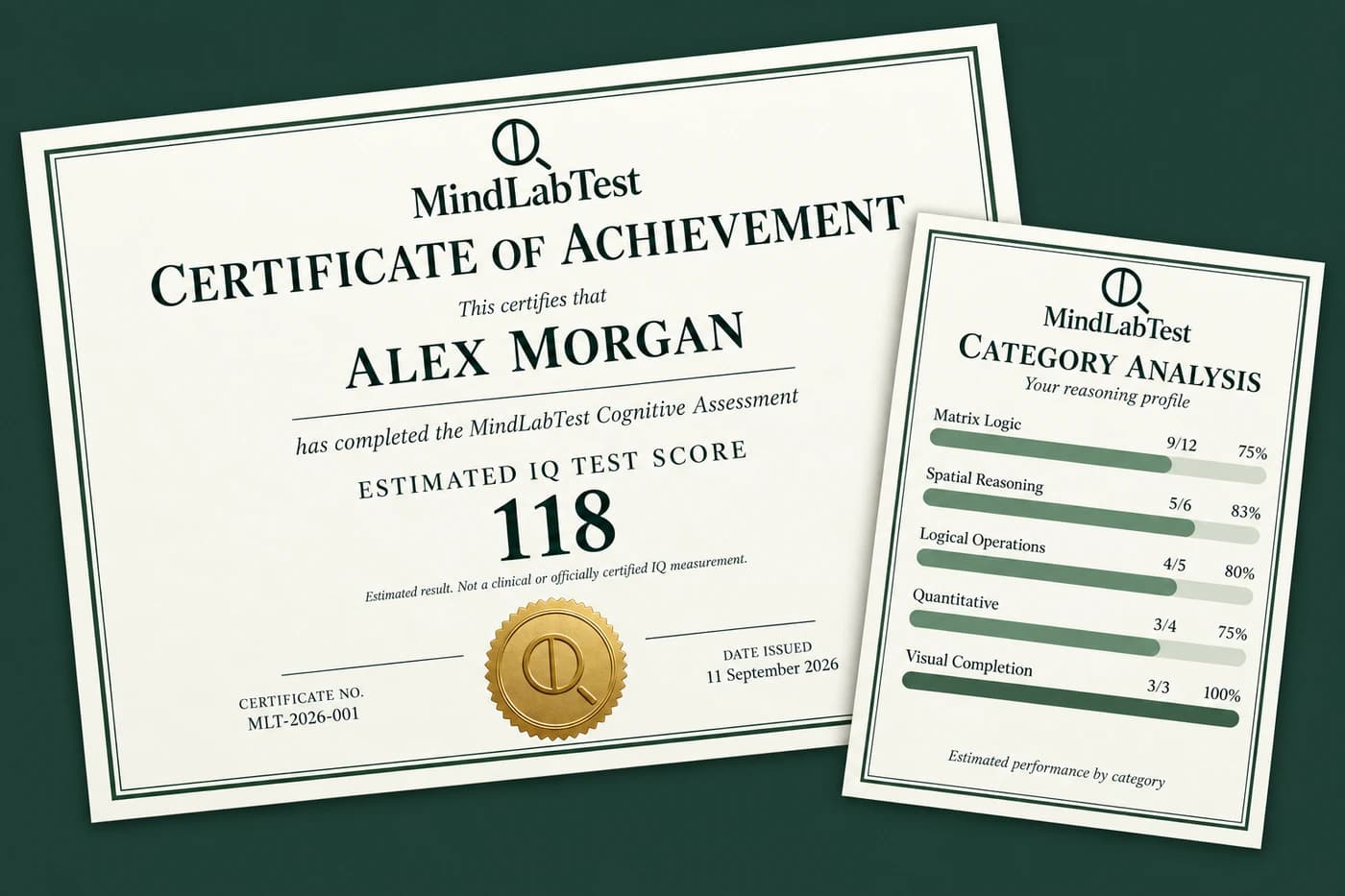
See your estimated score alongside correct-answer rates in five reasoning areas. Your report explains the aims of each category and records your performance on this test.
Five areas, different reasoning demands. These descriptions explain the aims of the tasks; the report shows your accuracy in each area on this test.
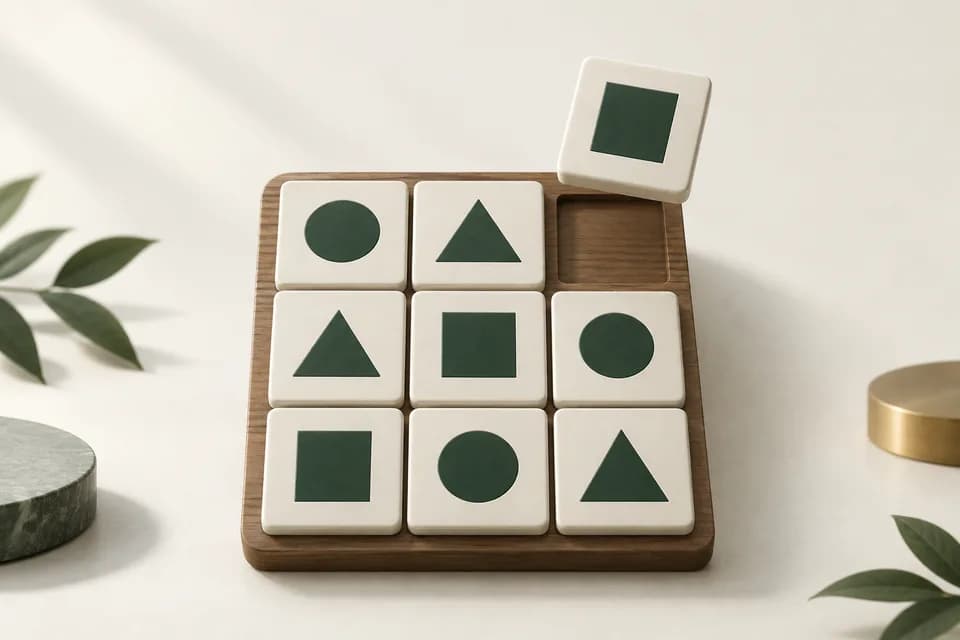
Aims to assess how you discover relationships between shapes, quantities and positions, then combine rules to infer a missing element. The focus is finding a rule that works across the whole pattern.
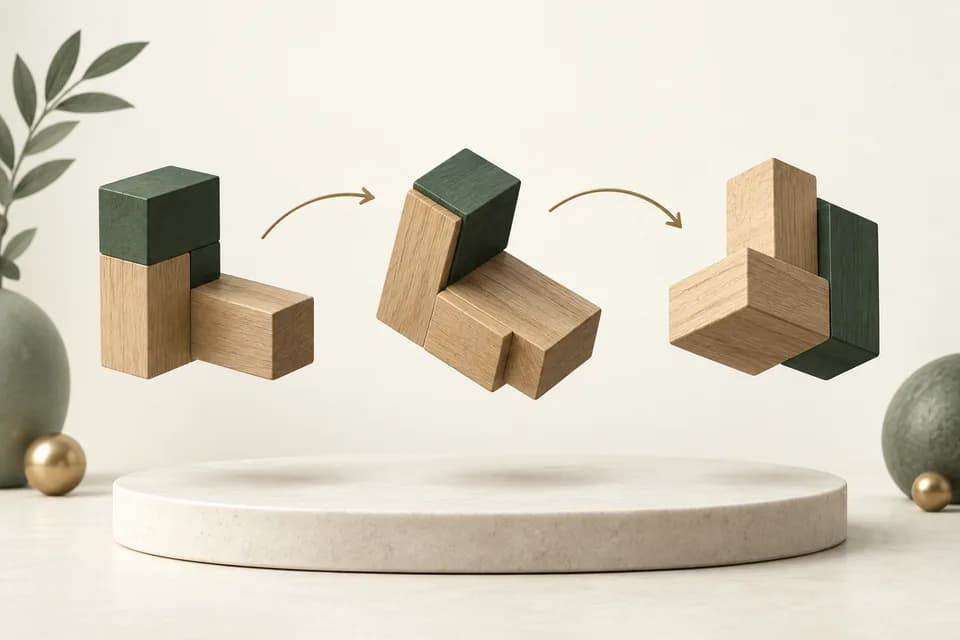
Aims to assess how you imagine changes in orientation and how parts fit together. Tasks such as rotation, reflection, unfolding paper and assembling pieces draw on this ability to mentally transform shapes.

Aims to assess how you infer a rule, apply conditions consistently and carry out operations in the right order. The focus is combining information, distinguishing shared and different features, and checking the resulting conclusion.

Aims to assess how you uncover relationships between numbers and quantities to find an unknown value. Tasks such as alternating sequences and symbol equations require you to choose and combine arithmetic rules.
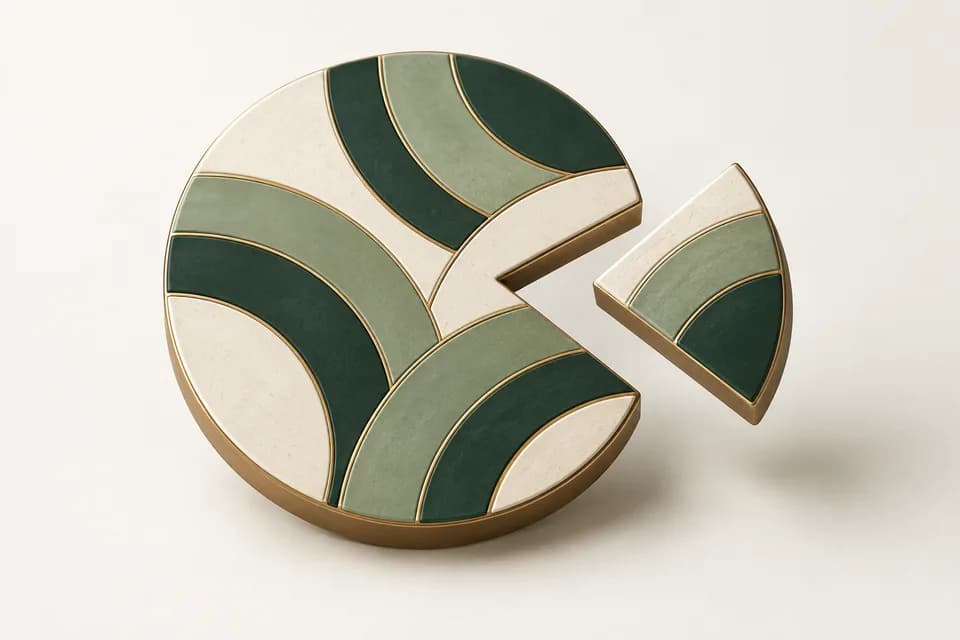
Aims to assess how you reconstruct a whole from incomplete visual information. You use the continuity of edges, lines and shapes to distinguish the missing piece from similar alternatives.
Test-takers who choose to publish their result appear here. Updates in real time. Completion time is never shown.
StudentTeacher / EducatorEngineerSoftware DeveloperHealthcare ProfessionalResearcher / AcademicDesigner / Creative ProfessionalFinance / AccountingLegal ProfessionalEntrepreneur / Business Owner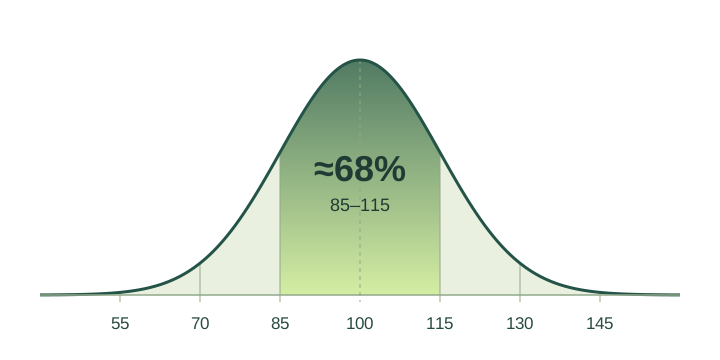
The normal model used for standardized IQ scores places about 68% between 85 and 115. This is a literature-based reference, not participant data or a simulation. MindLabTest scores remain provisional estimates; this curve does not validate our test.
Source: Epelbaum & Cacciamani (2023), §3.2 · NCBI Bookshelf ↗Challenge a friend to a live IQ battle and meet curious minds in the community.

Invite a friend, find an opponent in Community, or post an open challenge. Race for the first correct answer on the same 20 questions.

Find people, make friends and invite them to a friendly Challenge.
Patterns, shapes, numbers and logic. 30 questions at your own pace. Start without an account.